Now that the hybrid working structure is generally considered the norm – for many offices, the real challenge is designing to add value for employees and appeal more than working from home.
1. Purposeful Zones for Varied Use
Now that people don’t come into the office simply to sit at the same desk every day, every zone must earn its place.
- Collaboration hubs: Spaces for ideation, team workshops, and meeting face-to-face.
- Focus zones: Quiet rooms or booths for deep work – when remote may no longer suffice.
- Touchdown and agile spaces: For employees who split their week between home and office.
- Social/ culture zones: Casual areas that fuel connection and community, often the reason people choose to come in.
A hybrid-ready office is about choice. It delivers settings people can choose for how they feel or what they need that day.
2. Technology and Infrastructure that Actually Works
Hybrid working depends on tech… and when it fails, so does the experience.
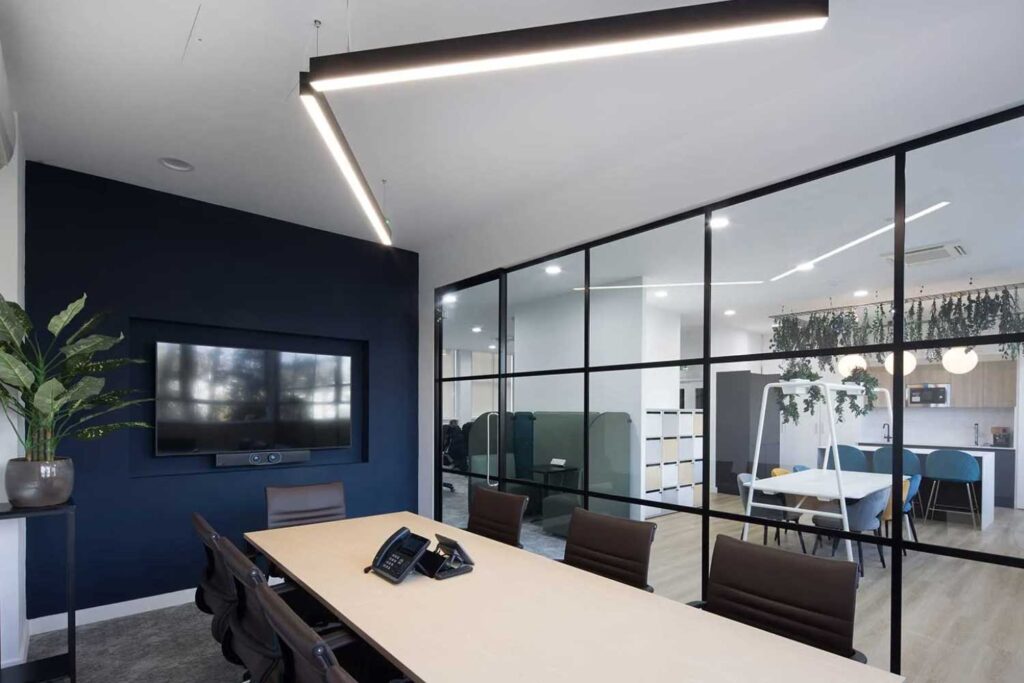
- Video-enabled meeting spaces, with no extra effort but full functionality.
- Flexible power and data hubs built into benches and shared tables.
- Booking systems or apps for desks, meeting rooms, and collaborative zones.
- Sensors or analytics tracking occupancy, peak usage and adaptation needs.
Your infrastructure must enable performance, not stunt it. If your employees have a more seamless tech experience from the comfort of their own home, there’s almost a zero chance of enticing them to make the commute.
3. Flexible Design
The days of fixed layouts and static furniture are over. Hybrid means consistently changing layouts.
- Modular walls, moveable partitions, and adaptive furniture allow spaces to shift.
- Multi-purpose zones mean space isn’t under-used on quieter days.
- Scalable layouts ensure you’re not constrained now or ill-prepared in a year’s time.
Designing for flexibility means you’re not always re-fitting; you’re evolving.
4. Belonging, Presence and Connection
100% remote working in 2020 and 2021 highlighted what we missed – serendipitous chats, team culture, the ‘water-cooler’ effect. The office must support those moments of connection.
- Design informal paths and shared spaces where people can meet naturally.
- Create visible hubs of activity that draw people in, rather than isolated rows of desks.
- Offer identity and belonging for all users—frequent visitors, part-time attenders, remote-heavy staff.
The most successful offices in hybrid settings are based in the idea of community.
5. Analytics and Continuous Optimisation
Hybrid work patterns are still shifting. The best offices continue to prioritise learning from employee behaviours.
- Collect analytics on how often desks, zones and amenities are used.
- Review what under-performs and reconfigure accordingly.
- Maintain a roadmap for the next 12–18 months.
As usage patterns evolve, flexibility is essential.
An office designed for hybrid work is about creating a place that connects teams, supports individuals, flexes with change, and offers something that home or remote spaces can’t: presence, community and experience. If you’re thinking about your next fit-out, design consideration or investment make sure to consider this: What does the space give people that they can’t already get at home?