
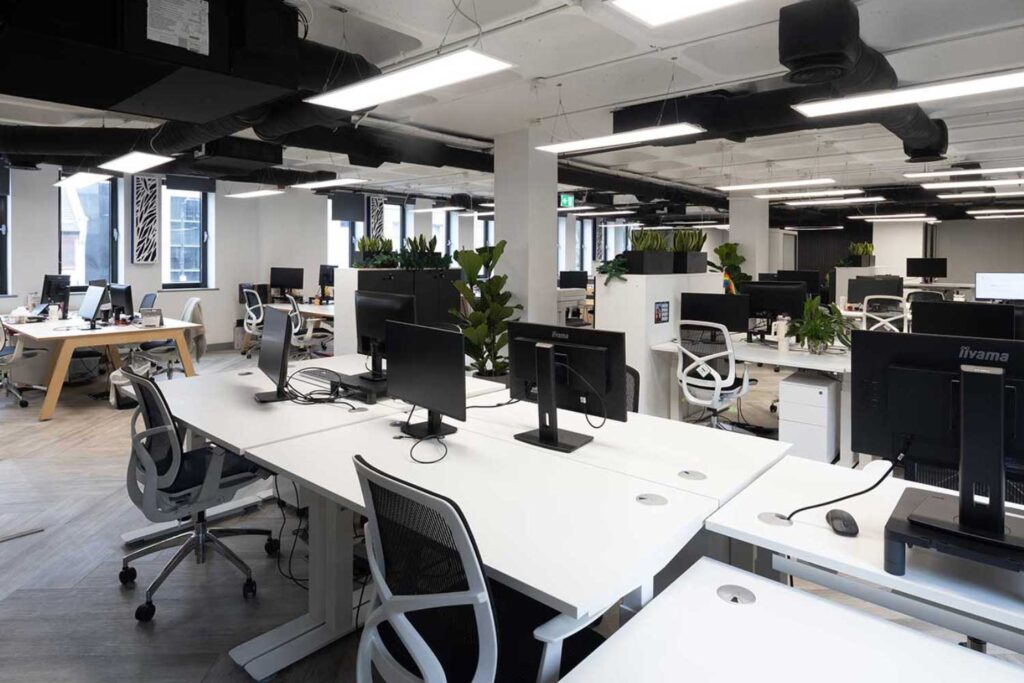
When you’re planning an office fit-out or refurbishment, the first thing you’ll need to understand is the level of finish you actually need? The answer depends on the building, lease terms, tenant needs, and your long-term strategy.
In this guide, we’ll walk you through the main fit-out categories and how they are relevant to businesses with their own office, and landlords looking to get their office prepared for prospective clients.
Fit-Out Categories Explained
Category A (Cat A)
Cat A includes basic finishes, mechanical & electrical services to current standards, ceilings/flooring, lighting and service cores.
Historically this is the level of fit out a landlord would prepare before renting out an office space. Although this type of fit-out might still be relevant for enticing tenants that want to customise but need a clean, compliant starting point – recently the expectation of the landlord from the tenant has shifted to A+.
Category A+ (Cat A+)
An enhanced version of Cat A, this level includes additional furnishings, partitioning and finishes, so the space is closer to ‘move-in ready.’
This is ideal for tenants wanting minimal delay and a space that’s largely furnished and ready to occupy and has become far more expected.
Category B (Cat B)
Cat B is the full bespoke fit-out tailored to the tenant’s brand, layout, furnishings, IT/AV infrastructure and finishes. It turns a Cat A into a fully functioning, branded workplace.
Best when: you are a business trying to foster a very specific culture, brand, growth or technology requirements.
So… Which Fit-Out Do You Need?
Business’s looking to update their office:
Here are key considerations to help you choose:
- Your business growth trajectory: If you expect rapid expansion or contraction, opt for a fit-out that supports flexibility (Cat B or modular Cat A+).
- Timeline to occupation: If you need to move in quickly Cat A+ is most efficient.
- Budget constraints: Cat A+ is typically lower cost; Cat B requires more upfront investment.
- Brand and culture: If your workspace is a key part of your company identity (brand, talent attraction, client impressions), the move toward Cat B is more likely.
- Landlord vs tenant responsibilities: Understand what the landlord provides and what you’ll need to cover – this affects both cost and timeline.
Landlords looking to update their office:
For commercial landlords preparing for a new tenant, market conditions in 2026 increasingly expect a higher base standard. Here are typical deliverables:
1. A Clean and Compliant Shell
- Basic services installed (HVAC, lighting, power distribution, fire alarms) at current performance standards.
- Adequate access to floor plates, lifts, clean washrooms, and communal areas.
2. Defined Fit-Out Standard
- Clear specification of what finishes, ceilings, flooring, and services the tenant inherits. A well-executed Cat A or Cat A+ provides transparency and reduces risk.
- Specification should include upgrade capacity (e.g., extra power/data, modular services) so tenants don’t face hidden surprises.
3. Flexibility & Infrastructure Capacity
- Landlords should aim to provide mechanical/electrical services that have capacity for adaptation (layout changes, increased density, newer tech) rather than just static configuration.
- Deliver spaces with modular infrastructure (raised floors, service voids, accessible cabling) to support tenant future-proofing.
4. Pre-Tenant Snagging and Commissioning
- Ensure the base building is properly commissioned (services working, finishes to expected standard) so tenant fit-out phases aren’t delayed by remedial work.
- Clear documentation of base condition, maintenance manuals, and access to service records to reduce risk at hand-over.
5. Transparent Handover and Dilapidation Strategy
- Provide a well-defined hand-over plan, timelines, and drawings.
- Clarify responsibilities for lease end (dilapidations) so tenants understand future obligations.
Choosing the right fit-out level is a strategic decision that affects cost, timelines, branding, flexibility and future adaptability. Whether you opt for Cat A, Cat A+, or Cat B, the key is aligning it with your business goals and expected use of the space.
If you’re a landlord, providing a strong base environment supports tenant satisfaction and longevity. If you’re a tenant, understanding what you’re inheriting and what you’ll need to invest is essential to avoid surprises.